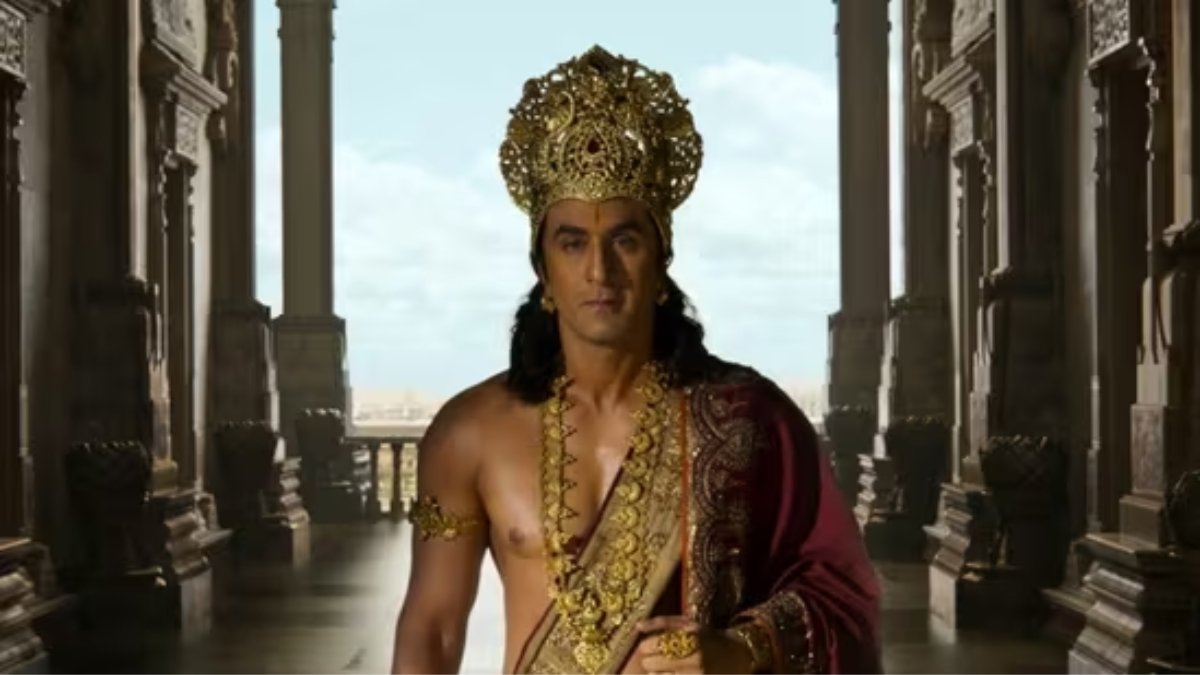
The first glimpse of Ramayana is finally here—and it’s doing more than just introducing its star-studded cast. With Ranbir Kapoor stepping into the role of Lord Rama, the teaser quietly packs in layered storytelling, mythological callbacks, and emotional beats that many viewers may have missed on first watch. No dialogues. Just visuals. But they speak volumes.
The introductory teaser for Ramayana, directed by Nitesh Tiwari and produced by Namit Malhotra, was released in India this week after debuting in the US. Featuring Sai Pallavi as Sita and Yash as Ravana, the teaser avoids dialogue entirely, relying instead on striking imagery to map out one of mythology’s most iconic journeys.
But look closer, and a clear narrative begins to emerge.
Ramayana teaser opens with Sita swayamvar and Rama’s defining moment
One of the most telling visuals comes early—the sequence referencing Sita’s swayamvar. In the epic, King Janaka challenges suitors to lift and string the mighty Pinaka bow.
The teaser shows Rama doing exactly that. Calm. Effortless. Decisive.
And then, it breaks.
That snap is significant. In traditional tellings, the breaking of the bow is not just a feat of strength—it’s the moment that seals Rama and Sita’s destiny. The petal shower and celebratory crowd glimpsed in the teaser reinforce this turning point, hinting that the film will lean into the grandeur of this union.
From coronation to exile: a visual shift that defines Rama’s arc
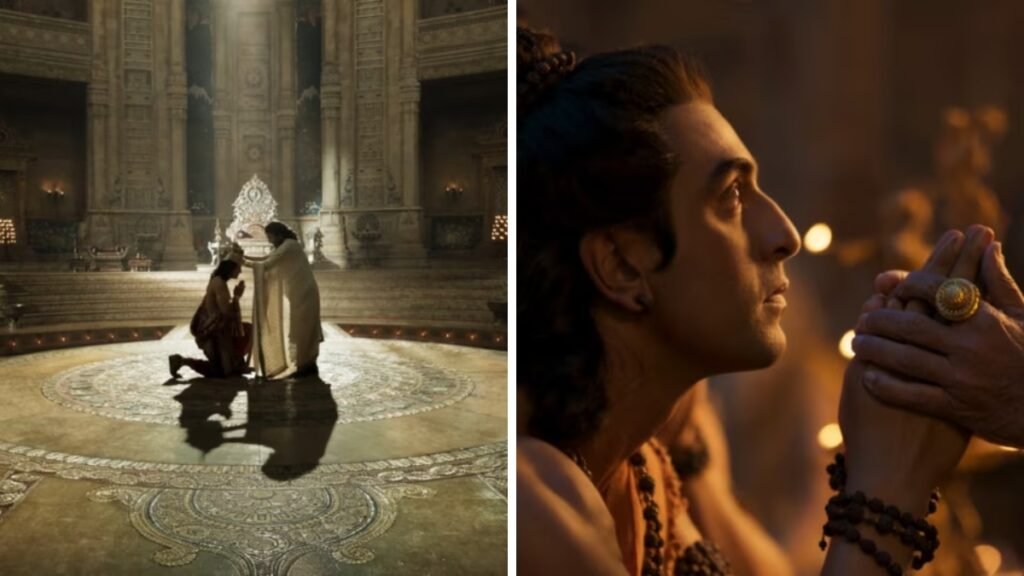
In a matter of seconds, the teaser transitions from opulence to heartbreak.
We see Rama dressed in royal finery, moments away from being crowned by King Dasharatha. Then, abruptly, the tone shifts—he appears in simple robes, bidding farewell to his father.
No exposition. Just contrast.
The imagery of the chariot, driven through a grieving crowd, adds emotional weight. This is not just exile; it’s a public rupture. According to the epic, Rama abandons the chariot shortly after leaving Ayodhya—a detail that the teaser subtly acknowledges.
It’s a clever storytelling choice. Instead of spelling out the narrative, the film trusts the audience to feel the loss.
Dandaka forest sequences hint at large-scale action and mythological battles
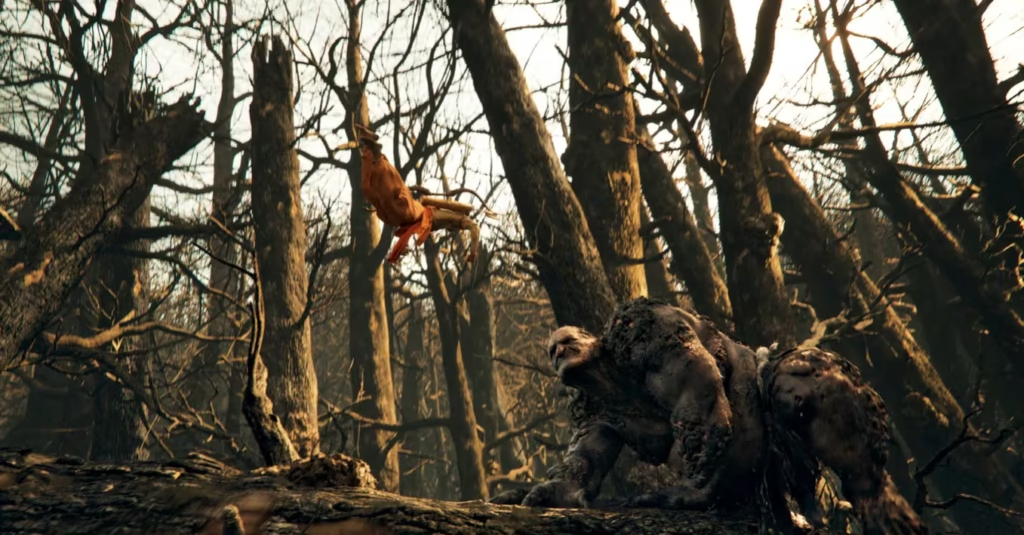
The teaser opens with chaos—a giant, troll-like figure wreaking havoc. While not explicitly identified, this likely draws from the Aranya Kaand, where Rama battles several rakshasas in the Dandaka forest.
Names like Maricha, Khara, and Dushana come to mind.
But here’s where the film appears to take creative liberties. The creatures resemble fantasy-style giants rather than traditional depictions. That shift could signal a broader attempt to globalise the visual language of Ramayana, aligning it with modern epic cinema.
A risky move—but potentially a strategic one.
Jatayu’s last rites: a quiet emotional core in the Ramayana teaser
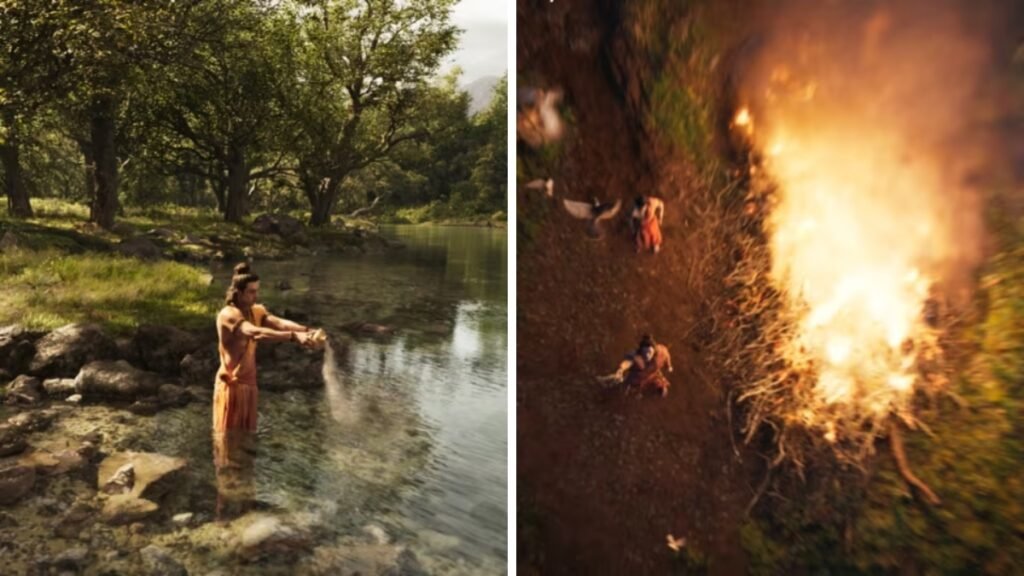
Amid the spectacle, one moment stands out for its restraint.
A sequence appears to show Rama performing last rites—widely believed to reference Jatayu, the noble bird who dies trying to save Sita from Ravana. In the epic, Rama honours him like a father, performing full funeral rituals.
It’s one of the most human moments in the story.
Including it in a teaser packed with scale and VFX suggests the film isn’t ignoring emotional depth. In fact, it may be leaning into it more than expected.
Ravana’s Pushpaka Viman gets a striking new design
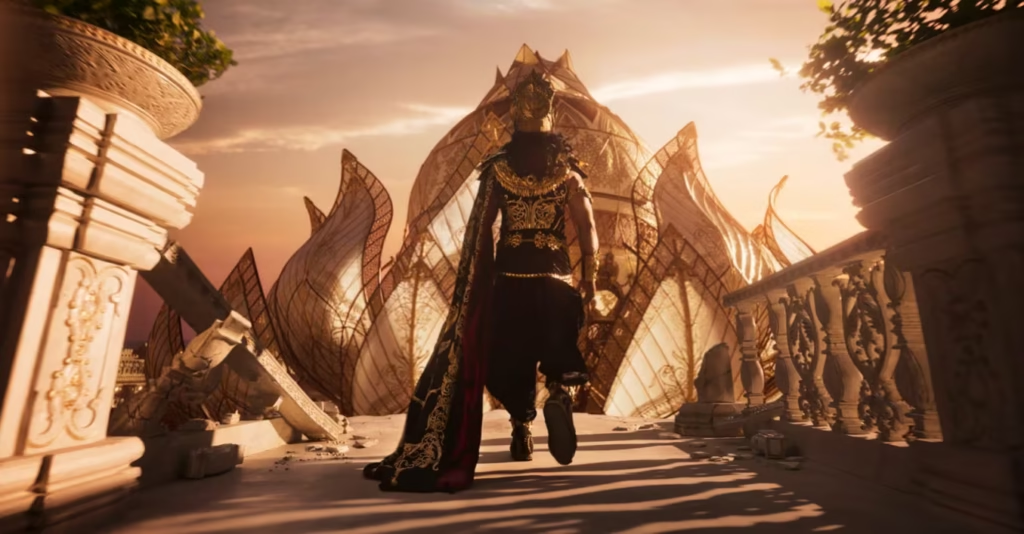
Then comes Ravana’s world.
The Pushpaka Viman—traditionally described as a divine flying chariot—is reimagined here as a lotus-shaped aerial structure. Designed originally by Vishvakarma for Kubera and later seized by Ravana, it plays a crucial role in Sita’s abduction and Rama’s eventual return.
This reinterpretation is visually intricate and symbolic.
The lotus motif could represent divinity, power, or even contrast—beauty masking tyranny. Either way, it signals that the film is not just recreating mythology, but redesigning it.
Why this Ramayana teaser matters in today’s cinematic landscape
This teaser arrives at a time when Indian cinema is still recalibrating its approach to mythological storytelling. After the mixed reception to recent adaptations, the stakes are unusually high.
What stands out here is intent.
Instead of overwhelming viewers with exposition, the teaser builds intrigue through fragments—moments that require recognition, not explanation. It respects the audience’s familiarity with the epic while reimagining its scale for a global stage.
And that’s the real test.
Can a story as sacred and widely known as Ramayana feel fresh without losing its soul? This teaser suggests the filmmakers are at least asking the right questions.
With Ramayana: Part 1 slated for Diwali 2026 and Part 2 in 2027, this teaser sets the tone for something ambitious—visually grand, emotionally aware, and culturally significant. The real challenge now lies in delivering on that promise.
ALSO READ: Ranbir Kapoor’s Ramayana Links Back to 1934 Kapoor Legacy