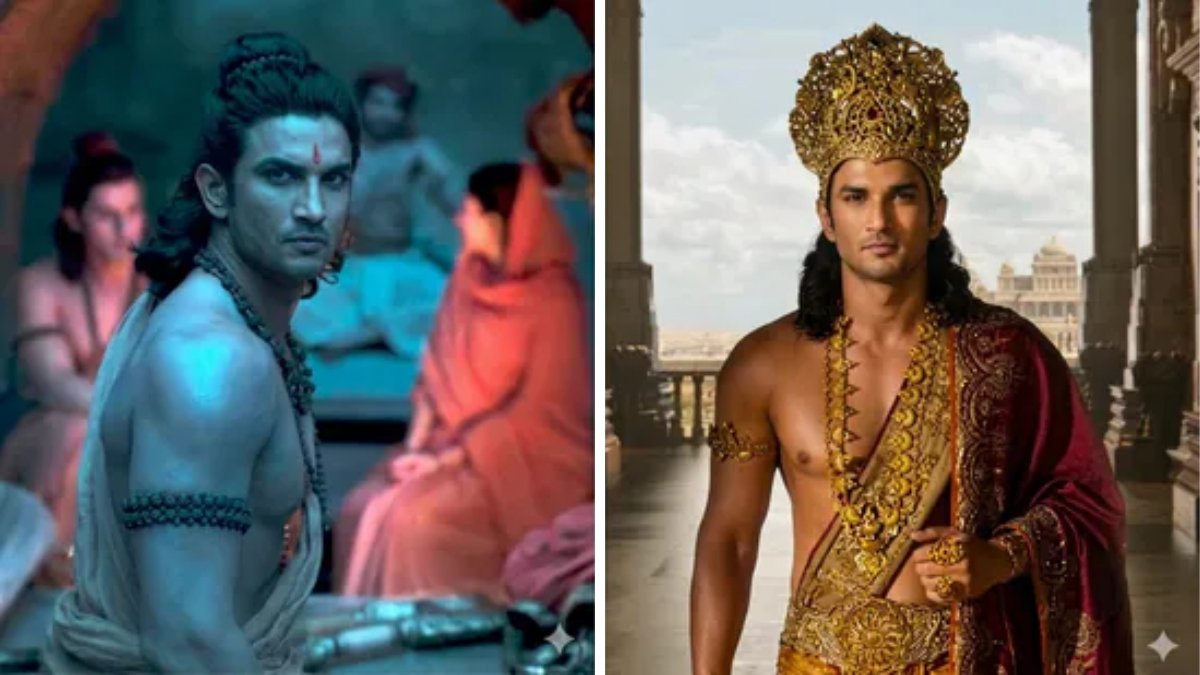
The first glimpse of Ramayana has barely settled online, but the internet is already imagining an alternate reality. AI-generated images showing late actor Sushant Singh Rajput as Lord Rama have gone viral, triggering an emotional debate among fans—many saying the actor might have been a more fitting choice than Ranbir Kapoor.
When AI Reimagined Sushant Singh Rajput as Lord Ram
The discussion began after the teaser for Ramayana revealed the first look of Ranbir Kapoor as Lord Rama.
Soon after, a Reddit user shared AI-generated images imagining Sushant Singh Rajput in the same frames from the teaser. The post, titled “He would have been better,” quickly gained traction online.
The images recreated two key moments shown in the teaser. One frame places Sushant as Rama in regal attire inside the Ayodhya court, while another depicts him during the vanvaas sequence, sitting on a boat in the forest.
The resemblance sparked a wave of nostalgia among fans.
And a debate.
Fans Debate Whether Sushant Would Have Fit the Role Better
In the comment section, several users argued that Sushant’s personality and screen presence matched the image of Lord Rama more closely.
One user wrote that the actor had “kind eyes and a calming aura,” traits often associated with Maryada Purushottam Rama. Another added that Sushant carried both calmness and intensity—qualities that mythological characters often require.
Some reactions were emotional rather than analytical. One comment read: “He would have been the best Rama. Seeing this post brought back all the feelings from when he died.”
But not everyone agreed.
A few users pushed back, noting that the debate around appearance—including skin tone—applied equally to both actors. One commenter argued that if the criticism of Ranbir was about complexion, the AI images did not fully resolve that issue either.
That tension reflects something deeper about mythological casting in Indian cinema: audiences often expect actors to embody not just a role, but an ideal.
Why Casting Lord Ram Always Sparks Strong Reactions
Portraying Lord Rama has historically carried cultural weight in India. The role is not treated like a conventional film character—it’s seen as symbolic.
Actors who have played the role in the past, such as Arun Govil in the iconic Ramayan, became closely associated with the character in public memory.
That legacy shapes expectations today.
For many viewers, Lord Rama represents calmness, moral authority and spiritual composure. Fans often judge casting decisions based on whether an actor’s public persona aligns with that perception.
It partly explains why AI-generated images imagining Sushant in the role resonated so strongly online. The late actor, known for films like MS Dhoni: The Untold Story and Kedarnath, often projected a quiet, introspective energy on screen.
Sometimes that matters as much as physical resemblance.
The Massive Scale of Nitesh Tiwari’s Ramayana
Meanwhile, expectations surrounding Nitesh Tiwari’s ambitious adaptation remain enormous.
Mounted on an estimated ₹4000 crore budget, the project is being described as the most expensive Indian film ever produced. The cast includes:
- Ranbir Kapoor as Lord Rama
- Yash as Ravana
- Sai Pallavi as Sita
- Sunny Deol as Hanuman
- Ravie Dubey as Lakshman
The teaser briefly showcased several characters, including Lakshman and Sita, before ending with a glimpse of Ravana emerging with the legendary Pushpak Vimana.
Part one of the film is scheduled to release in October 2026, with the second installment expected in 2027.
A Legacy That Still Resonates
Sushant Singh Rajput died in June 2020 at the age of 34. Police investigations later ruled his death a suicide.
Nearly six years later, moments like this—unexpected, internet-driven, and emotional—show how deeply his presence still lingers in public memory.
Even an AI image can reopen that conversation.
As anticipation builds around Ramayana, the viral images reveal something else entirely: fans are not just watching the film unfold—they’re imagining alternate versions of it. And sometimes, those imagined stories travel just as far as the real one.