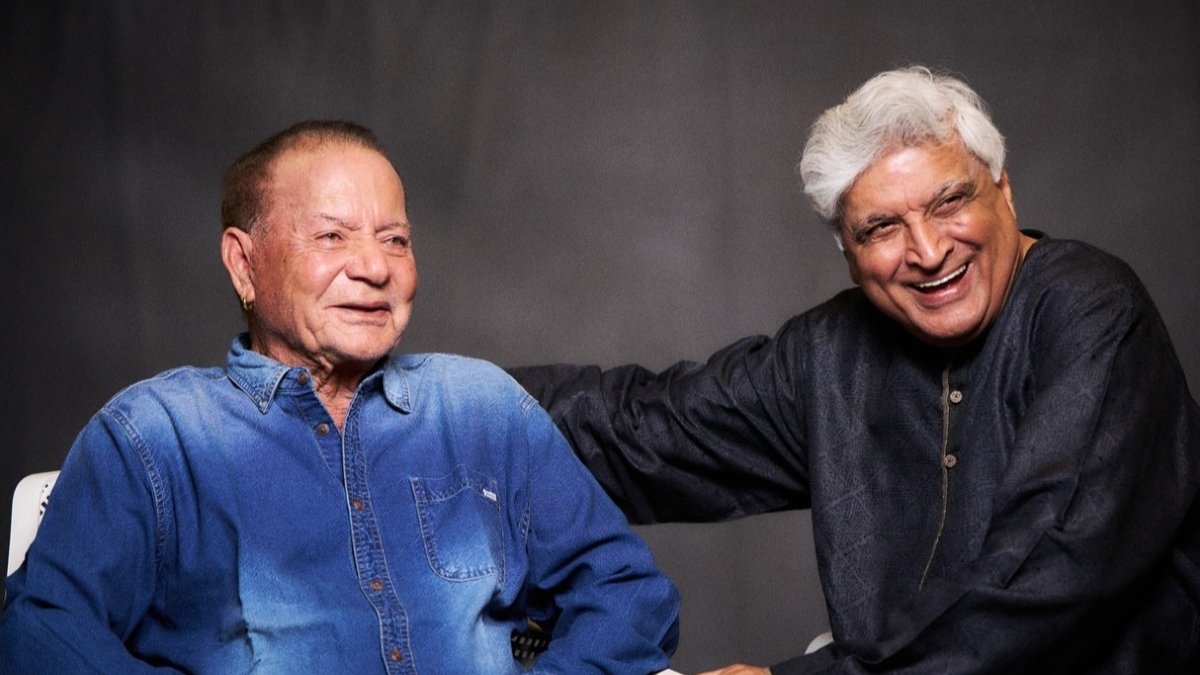
They met on a film set neither of them wanted to be on. One was a failed actor. The other was so broke he sometimes went hungry. Within a decade, Salim Khan and Javed Akhtar reinvented the Bollywood formula with an extraordinary lineup of superhits, becoming game changers at a time when screenwriting was dismissed as a back-room job. This is the story of how they did it.
Two Struggling Men, One Accidental Partnership
Salim met Javed Akhtar for the first time during the making of the film Sarhadi Lootera. Javed, who served as a clapper boy when shooting began, was later made the dialogue writer for the film by the director. Their friendship developed further because their bosses were neighbours to each other.
Salim wrote plots and stories. Javed shaped the dialogue and the poetry. The division of labour was clean. The result was explosive.
Their early work was modest. Their first big success was the script for Andaz, followed by Adhikar (1971), Haathi Mere Saathi and Seeta Aur Geeta (1972). But these were warm-up acts. The real revolution was still coming.
Zanjeer: The Film That Started Everything
In 1973, Zanjeer, written by Salim-Javed and directed by Prakash Mehra, launched the original “angry young man” Amitabh Bachchan into superstardom — before that, Bachchan had appeared in a string of forgettable films.
The screenplay of Zanjeer was almost entirely written by Salim Khan alone, before he brought Javed Akhtar on board. Salim Khan was also personally responsible for introducing Bachchan to directors such as Prakash Mehra and Manmohan Desai.
That decision changed everything. Bachchan’s brooding, contained fury fit the Salim-Javed hero like a second skin. The “angry young man” was an anti-establishment hero who emerged in Salim-Javed films during the mid-1970s. He reflected the socio-economic realities of the time.
1975: The Year They Peaked
No year defines the Salim-Javed legacy more than 1975. In that single year, the duo delivered both Deewar and Sholay — two films so different in tone, yet both utterly dominant.
Deewaar (1975), which pitted “a policeman against his brother, a gang leader based on real-life smuggler Haji Mastan,” was described as being “absolutely key to Indian cinema” by Danny Boyle.
Sholay, released the same year, became something else entirely. It transcends genres: at once a dacoit drama, an action-thriller, a buddy film, a comedy, a romance, a tragedy, and a morality tale. Sholay is all things to all fans.
Bachchan starred in 11 of Salim-Javed’s roughly two dozen films and played a character named Vijay in 8 of them. The collaboration between writer and actor became Bollywood’s most potent creative engine.
More Than Entertainment — A Mirror to India
Salim-Javed’s films reflected the socio-economic and socio-political realities of 1970s India. They channelled the growing popular discontent among the masses, the failure of the state to ensure welfare, rapidly rising prices, scarce commodities, and smugglers gathering political clout.
Their scripts were India’s emotional pressure valve. The angry young man did not just entertain — he gave a generation permission to feel its rage.
Salim-Javed’s screenplays were also remarkable for their depiction of women. Female characters had agency, dignity, and very often, careers. Hema Malini played several empowered women, such as Basanti in Sholay — a horse-and-cart driver, a traditionally male profession.
The Split and the Legacy
The duo’s split in 1982 remains uncertain in its exact cause. Javed Akhtar acknowledges that “Fatigue had set in our partnership, and that started showing in our work.” “We separated in a very civil manner and remember only the good times,” adds Salim Khan.
They were not even on speaking terms after their split until 2012, when their original script Zanjeer saw a remake.
Yet their influence never stopped. Screenwriter V. Vijayendra Prasad, responsible for blockbusters including the Baahubali franchise and Bajrangi Bhaijaan, cited Salim-Javed as a major inspiration, especially their screenplay for Sholay.
Zoya Akhtar, daughter of Javed Akhtar, put it plainly: “There is nobody else who has managed as writers to create that kind of niche for themselves or garner that kind of attention in a Bollywood industry obsessed with heroes.”
No screenwriting duo since has come close.
By the Numbers: The Salim-Javed Filmography
- Films written together: 24
- Filmfare Awards: Best Story and Screenplay (Zanjeer, 1974), Best Story, Screenplay and Dialogue (Deewar, 1976), Best Screenplay (Shakti, 1983)
- Box office record: Sholay held the highest-grossing Hindi film record for 19 years
- Iconic characters created: The Angry Young Man, Gabbar Singh, Jai and Veeru, Vijay Verma
- Years active together: 1971–1982
This article is part of our tribute series on Salim Khan and the legacy of Indian cinema’s greatest screenwriting era.
READ NEXT: Sholay at 50: The Making of Bollywood’s Greatest Film
RELATED: Salim Khan Hospitalised: Family Vigil and a Legend’s Legacy