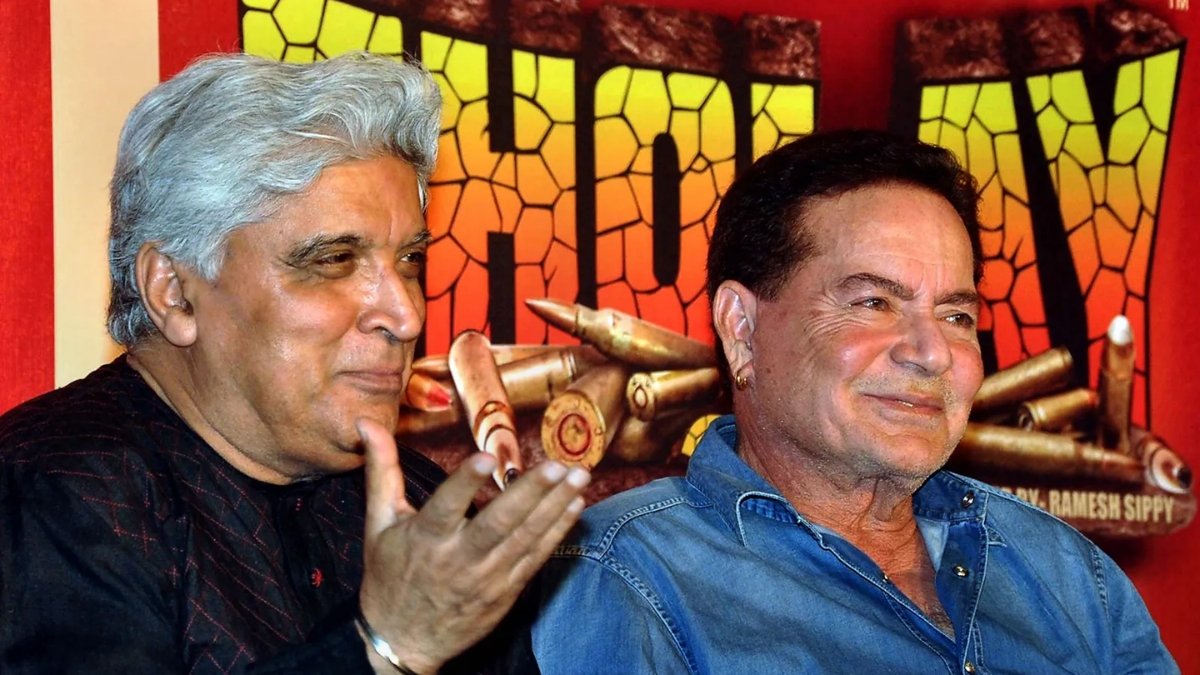
It started as four lines. It ended as legend. Sholay began as a four-line concept by writers Salim-Javed, who pitched the premise of two lovable guns-for-hire to producer G. P. Sippy and his son Ramesh Sippy. Nobody in that room that day could have imagined they were building the most beloved film in Indian cinema history.
Fifty years on, Sholay does not feel like history. It feels like yesterday.
The Pitch That Almost Never Happened
The screenwriter pair Salim-Javed began narrating the idea for Sholay as a four-line snippet to filmmakers in 1973. Two producer/director teams rejected it, including directors Manmohan Desai and Prakash Mehra.
Six months after Zanjeer released, Salim-Javed tried again. They took the idea to the Sippys. Director Ramesh Sippy loved the concept and decided to make the film. Salim-Javed completed the script in one month, incorporating names and personality traits of their friends and acquaintances.
The character of Thakur Baldev Singh even took his name from Salim Khan’s own father-in-law. The film was personal from the very first page.
Building the Cast: A Rocky Road to Perfection
Putting Sholay’s legendary ensemble together was far from straightforward.
While Dilip Kumar was approached for the role of Thakur but declined, Danny Denzongpa could not play Gabbar Singh because he was already shooting for Dharmatma. Amjad Khan stepped in as the second choice. He prepared for the role by reading Abhishapta Chambal, a book about the real Chambal dacoits.
The casting of Jai carried its own drama. Amitabh Bachchan had not had box office success for a while. Distributors were wary. But both Salim Khan and Dharmendra believed in him. He was cast after Salim-Javed recommended him; Bachchan’s performance in Zanjeer had convinced them he was right for the role.
Dharmendra’s casting as Veeru came with its own comedy. Dharmendra desperately wanted to play Thakur. But he was also deeply in love with Hema Malini. Sippy quietly pointed out that Thakur would have no romantic scenes. Dharmendra chose Veeru.
Two and a Half Years in the Rocks
Filming took place in the rocky terrain of Ramanagara, in the southern state of Karnataka, over two and a half years, beginning in October 1973. Sippy chose this landscape deliberately. While most dacoit films of that era were shot in Rajasthan or the Chambal region, he wanted a fresh visual setting that gave the film a distinct look and set it apart from its contemporaries.
The shoot became legendary for its obsessive perfectionism. The iconic scene of Radha extinguishing the lamps while Jai plays his harmonica took about 20 days to shoot. Sippy and cinematographer Dwarka Divecha waited each day for the brief “magic hour” between sunset and nightfall to capture the lighting they wanted.
The famous scene where Gabbar kills Thakur’s entire family took 23 days. Nothing on Sholay came easy. Every frame was earned.
The makeshift village set constructed at Ramanagara was never demolished. The local villagers asked Sippy to leave it standing. It came to be known as Sippy Nagar.
The Ending the World Never Saw — Until Now
The climax audiences have known for 50 years — where Gabbar Singh is arrested by the police — was not the ending that Salim-Javed originally wrote.
The censor board objected to the original climax in which Thakur Baldev Singh killed Gabbar Singh using his spiked shoes. The board argued that a police officer could not be shown taking revenge. The team reshot it. The visceral justice Salim-Javed intended sat unseen in a vault for decades.
To mark its 50th anniversary, Sippy Films and the Film Heritage Foundation carried out a full new restoration that reinstates Ramesh Sippy’s original ending. The restored Sholay premiered at the Il Cinema Ritrovato Festival in Bologna and screened at the Toronto International Film Festival. “Now you will see the movie as it was made,” Sippy told audiences.
Opening Weekend: The Near-Death of a Legend
Sholay began not with a bang but a whimper. Business was so slow that an emergency meeting took place over the first weekend to discuss whether a reshoot was needed to have Bachchan’s character Jai survive.
Director Ramesh Sippy decided to wait until Monday. And thank god — because after Monday it became history.
Sholay was the first film in India to celebrate a silver jubilee at over 100 theatres. In the several years after its initial release, Sholay collected 30 crore rupees — more than $350 million in 2025 dollars — and held the record for top-grossing Hindi film for 19 years.
Why Sholay Still Matters
Sholay has been described as the “Star Wars of Bollywood,” with its impact on Indian cinema comparable to the impact Star Wars had on Hollywood. The villain Gabbar Singh has been compared to Darth Vader.
The first intimations of immortality arrived when the film’s sales team reported hearing Sholay’s dialogue on the streets of Mumbai. Lines like “Kitne aadmi the?” did not just enter the cultural vocabulary — they became the vocabulary.
When asked to explain Sholay’s monumental success, Javed Akhtar had the most honest answer of all. “If I knew, I would have written another Sholay by now.”
Fifty years on, nobody has.
This article is part of our tribute series on Salim Khan and the legacy of Indian cinema’s greatest screenwriting era.
READ NEXT: Salim-Javed: How Two Writers Changed Hindi Cinema Forever
RELATED: Salim Khan Hospitalised: Family Vigil and a Legend’s Legacy