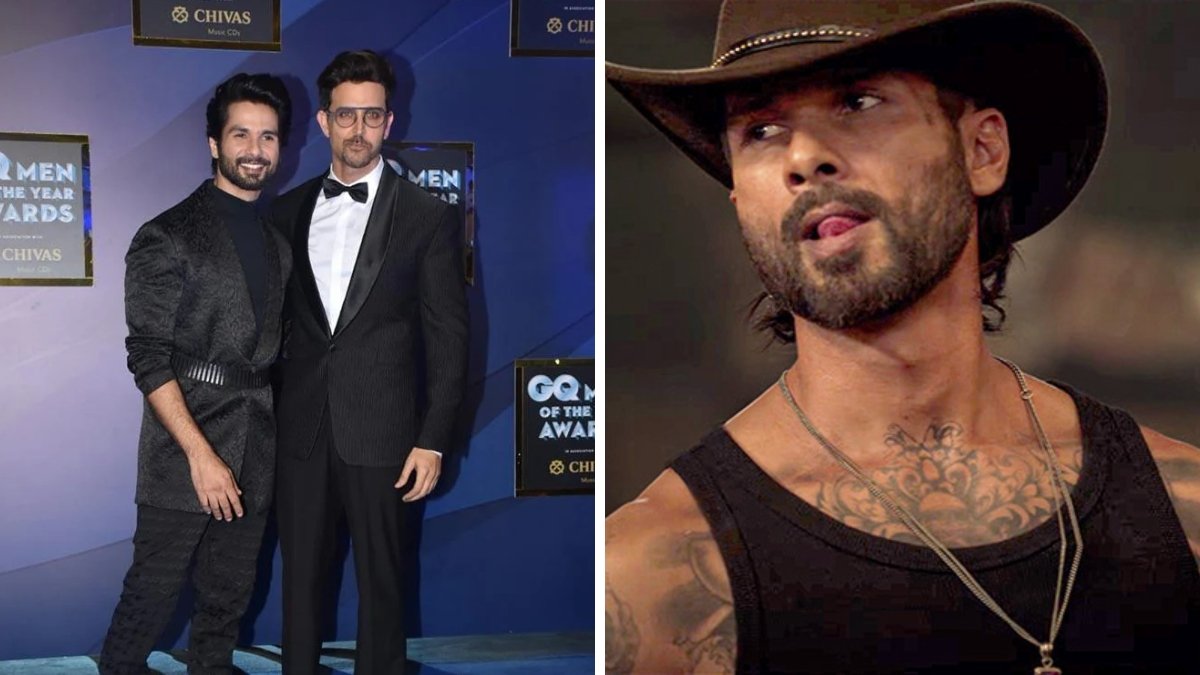
This Valentine’s Day, Shahid Kapoor returned to cinemas with a big film, a celebrated director, and high expectations. What he got instead was a divided audience — and an unexpected news cycle starring Hrithik Roshan.
Hrithik posted a warm review of O’Romeo on his official social media. Within hours, however, the internet buried the goodwill under a familiar question: why does Hrithik apply different standards to different films?
What Hrithik Actually Said About O’Romeo
Hrithik Roshan took to social media with a specific, enthusiastic review. He wrote: “The quirkiness of #ORomeo eventually wins you over. I had fun. @shahidkapoor you do this genre BEST. Too good you are. Go watch it in the theatres guys. Also that running in circles action was brilliant.”
This was not a vague courtesy tweet. He called out Shahid’s genre command, praised a specific stunt sequence, and actively asked fans to watch it in theatres. Some fans appreciated it immediately. One commented: “One talent recognises the other — so guys, ignore the negativity and go watch it for yourself.” Another wrote: “These two supporting each other will always be great.”
However, the appreciation lasted only a few hours. Then the Dhurandhar brigade arrived.
The Dhurandhar Comment That Started It All — A Quick Timeline
To understand the trolling, readers need the full timeline. Here it is, in order.
First, in 2009, Vishal Bhardwaj directed Shahid Kapoor in Kaminey — a critically acclaimed crime thriller that became a landmark in Shahid’s career. Then, in 2014, the duo reunited for Haider, an adaptation of Hamlet set in Kashmir. It earned Shahid some of the strongest reviews of his career.
Fast forward to late 2024. Aditya Dhar’s Dhurandhar released, starring Ranveer Singh. Hrithik Roshan reviewed the film publicly. He praised its storytelling and called it “amazing.” But he added that he “disagreed with the politics of it.” That one qualifier ignited a controversy. Many accused him of applying an ideological filter to cinema that he didn’t apply to other films.
Then, on February 14, 2025, O’Romeo hit theatres. The film stars Shahid Kapoor, Triptii Dimri, Nana Patekar, and Avinash Tiwary. It marks Shahid’s third collaboration with Vishal Bhardwaj. Critics and audiences gave it mixed responses.
Shortly after, Hrithik posted his glowing O’Romeo review — with no political caveats whatsoever. The internet immediately cross-referenced it with his Dhurandhar statement. The trolling followed within the hour.
Why the Trolling Hit So Hard This Time
The backlash was not random. It was specific, and it had receipts.
“So you liked this pathetic movie but hated Dhurandhar?” one netizen wrote. Another asked directly: “Don’t you see any politics in it as you saw in Dhurandhar?” Some users went further. They flagged a reported O’Romeo dialogue referencing the Babri era. Others pointed out that a Hindu character wearing a tilak is depicted as a villain in the film. They wanted to know why none of that triggered Hrithik’s political radar.
Notably, Hrithik has not responded to any of these comments so far.
Whether the criticism is fair is debatable. However, what is clear is that it landed. Moreover, it landed because Hrithik’s earlier Dhurandhar comment was unusually specific — and specificity, on social media, becomes a measuring stick.
What Most Entertainment Portals Are Missing in This Story
Most entertainment portals will report the tweet, copy the troll comments, and call it a controversy. However, this story is actually about something bigger — and readers deserve to know what that is.
Bollywood has always had a mutual appreciation culture. Stars tweet support for colleagues’ films. It is partly genuine, partly industry courtesy. For decades, nobody tracked it closely. Now, everything is different.
Social media has created a permanent, searchable archive of every public statement. Furthermore, audiences have become skilled at cross-referencing. When Hrithik praised Dhurandhar’s craft but flagged its politics, he set a standard. Fans filed that statement away. The moment he praised O’Romeo without the same scrutiny, they retrieved it — instantly, publicly, and without mercy.
This is a structural shift in how celebrity film reviews work in India. Stars can no longer operate in silos. Every review now exists alongside every previous review. In addition, any inconsistency — real or perceived — becomes a story in itself.
Hrithik is not alone in this trap. Several A-listers have faced similar scrutiny for selectively engaging with films. However, his Dhurandhar qualifier was unusually public and pointed. That is precisely what made his O’Romeo tweet so easy to challenge.
What This Means for Shahid Kapoor and O’Romeo
For Shahid, this moment cuts both ways. On one hand, Hrithik’s endorsement carries real weight. It was detailed, enthusiastic, and public. On the other hand, the controversy now surrounding that endorsement has overshadowed the film itself.
O’Romeo arrived with significant advantages. It boasts a Valentine’s Day release, a Vishal Bhardwaj direction, and a cast that includes the formidable Nana Patekar alongside Triptii Dimri and Avinash Tiwary. Despite these strengths, mixed reviews slowed its early momentum.
Ironically, Hrithik’s tweet — intended as an act of solidarity — has now generated more conversation around O’Romeo than most of its own promotional content. That is not necessarily a bad thing. Controversy drives curiosity. Some viewers may now watch the film specifically to judge it for themselves.
The Bigger Picture Bollywood Hasn’t Accepted Yet
Here is the uncomfortable truth that this episode reveals. Bollywood’s casual review culture was built for a pre-social media world. Stars could praise selectively, stay silent strategically, and face no consequences. That world no longer exists.
Today, every public statement is a data point. Every data point is eventually compared against every other. Therefore, when stars speak about films — especially with ideological or political caveats — they are not just reviewing a film. They are setting a standard they will be held to indefinitely.
Hrithik Roshan’s O’Romeo tweet was warm, genuine, and specific. However, it arrived carrying the weight of everything he had said before. That is not a Hrithik problem. That is a Bollywood problem — and the industry has not yet figured out how to solve it.