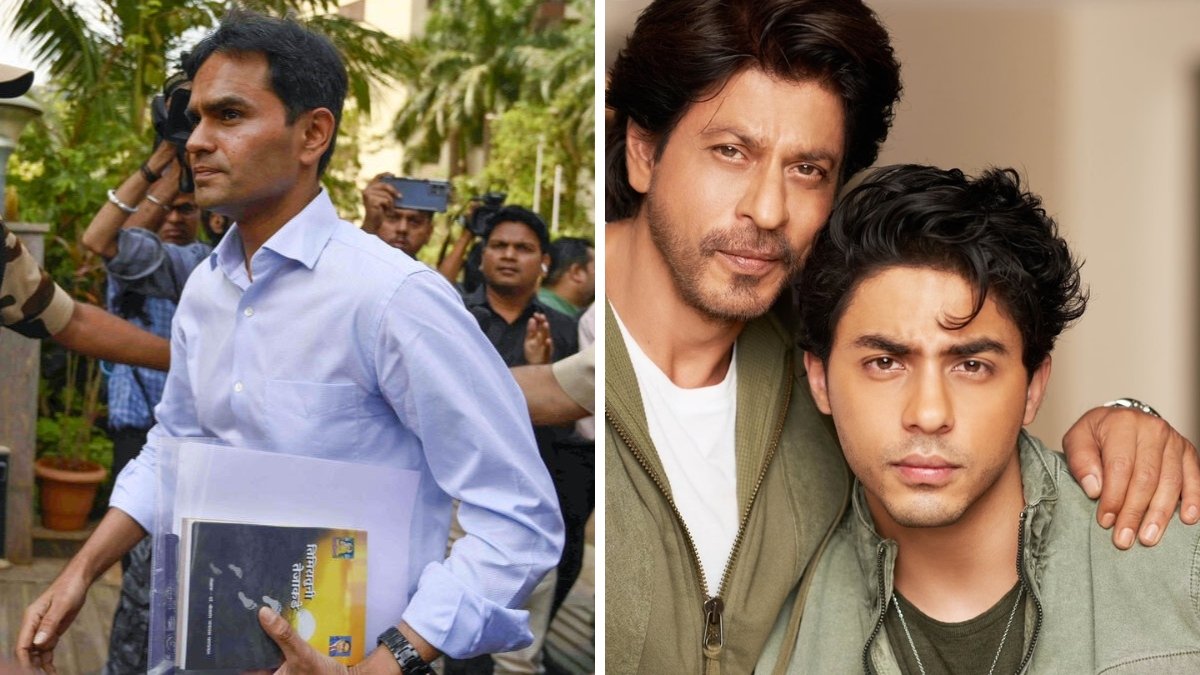
Sameer Wankhede walked into the Bombay High Court on Monday with one clear message — he never asked Shah Rukh Khan for a single rupee. The former NCB zonal director, facing a CBI bribery case and an ED money laundering probe, is now fighting to erase the FIR that has shadowed him since May 2023. His counsel told the court the agency has zero evidence to back the ₹25 crore bribe allegation.
Sameer Wankhede walked into the Bombay High Court on Monday with one clear message — he never asked Shah Rukh Khan for a single rupee. The former NCB zonal director, facing a CBI bribery case and a separate ED money laundering probe, is now fighting to erase the FIR that has followed him since May 2023. His counsel told the bench the agency has zero evidence to back the ₹25 crore bribe allegation.
Sameer Wankhede Bribe Case: What His Counsel Told Bombay High Court
Advocate Aabad Ponda argued before a bench of Chief Justice Shree Chandrashekhar and Justice Suman Shyam on Monday, pressing Wankhede’s plea to quash the CBI’s First Information Report. Ponda told the court his client — an Indian Revenue Service officer — never demanded or received any bribe from Shah Rukh Khan. He added that the NCB had acted lawfully throughout, responding to a tip-off about drugs aboard the Cordelia cruise ship before conducting a search and making arrests.
The argument was pointed and direct. According to Ponda, the CBI simply does not have the evidence to establish that any bribe was either demanded or accepted. That framing matters — because the FIR, filed on May 11, 2023, names five accused and rests on an allegation that has already been significantly complicated by the NCB’s own internal investigation.
The ₹25 Crore Allegation: What the CBI FIR Claims
The CBI FIR names Wankhede alongside former NCB SP Vishwa Vijay Singh, intelligence officer Ashish Ranjan, and two private individuals — Kiran Gosavi and Sanville D’Souza. Together, they allegedly demanded ₹25 crore from Shah Rukh Khan to ensure his son Aryan Khan was not framed in the October 2021 Cordelia drug case. The demand was subsequently reduced to ₹18 crore, according to the FIR.
Meanwhile, the Enforcement Directorate moved separately, filing a money laundering case against Wankhede in 2024. However, his legal team is currently focused on dismantling the CBI case at its foundation — arguing that without a valid FIR, the entire prosecution collapses.
Aryan Khan’s Arrest and the Cordelia Raid
Aryan Khan was arrested on October 3, 2021, a day after the NCB raided the Cordelia cruise ship in Mumbai. The arrest triggered one of the most heavily covered legal stories in recent Bollywood history. Wankhede, then the NCB’s Mumbai zonal director, led the operation. What followed was weeks of court hearings, public debate, and intense media scrutiny over whether the raid was conducted fairly.
An NCB SIT subsequently gave Aryan Khan a clean chit on May 27, finding he was not part of any larger drug-dealing network — directly contradicting the original framing of the case. That clean chit was significant. It quietly confirmed what critics had argued from the start.
NCB’s Own Probe Found Serious Procedural Lapses
Perhaps the most damaging detail in this case did not come from Wankhede’s critics. It came from within the NCB itself. The agency’s internal investigation revealed that the names of Aryan Khan and Arbaaz Merchant were added at the last moment to the official “information note” — a procedural irregularity that raises direct questions about whether the arrests were pre-planned or reactive.
Furthermore, the probe found that Wankhede’s team failed to properly document the seizure of phones and did not record statements in accordance with standard procedure. These are not minor oversights. In a criminal investigation, documentation failures can invalidate evidence entirely. The fact that the NCB’s own machinery flagged these gaps adds a layer of institutional self-correction that rarely gets the attention it deserves in mainstream coverage.
Why This Case Still Matters in 2026
The Cordelia cruise case has always been bigger than one arrest. It exposed fault lines in how India’s narcotics enforcement agencies operate — particularly when high-profile names are involved. Wankhede rose rapidly under public attention during his Mumbai posting, becoming a recognisable face of drug enforcement. That visibility now works against him as he fights corruption charges in the same courts where he once sent others.
The Bombay High Court hearing on Monday is one step in what will likely be a long legal process. Nevertheless, the case remains a benchmark for how institutional accountability — or its absence — plays out in India’s criminal justice system. For now, Wankhede’s legal team has drawn its line: no evidence, no bribe, no case.
The Bombay High Court is yet to rule on the quashing plea. Further hearings are expected.