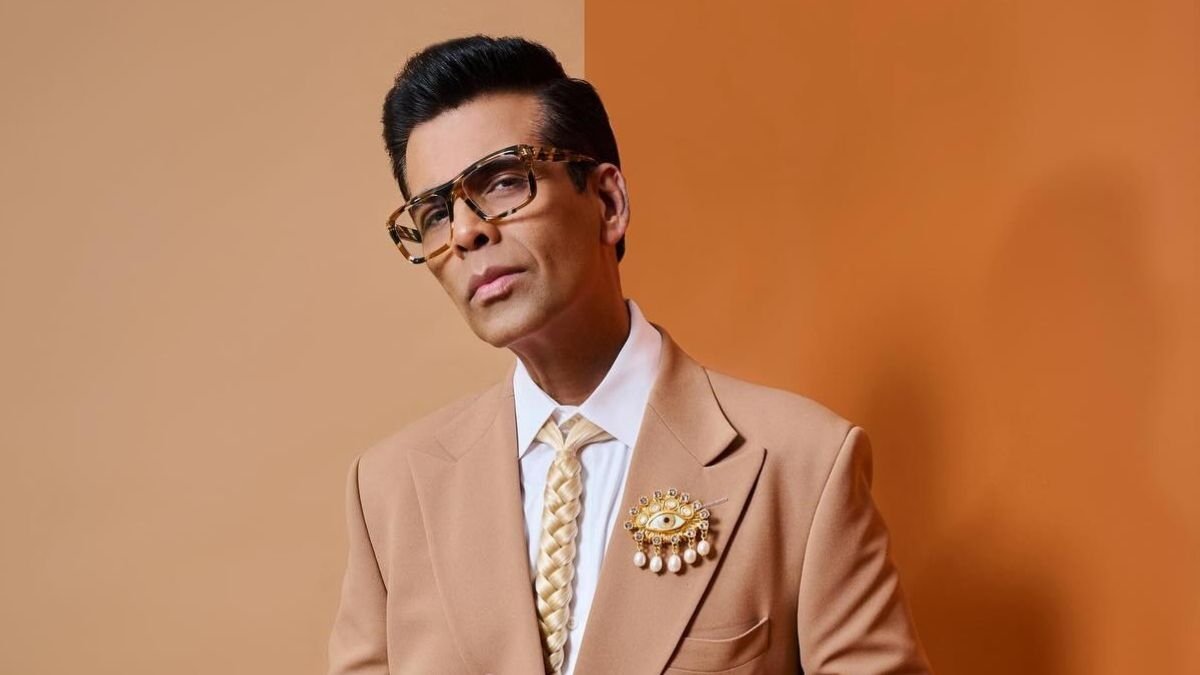
Karan Johar has spent 31 years surviving Bollywood’s mood swings. But it’s the talent management business — not filmmaking — that’s giving him his most unfiltered lessons in human nature. In a candid conversation with Sarthak Ahuja on SCREEN, the filmmaker and co-owner of Dharma Cornerstone Agency (DCAA) said what most industry insiders whisper but rarely say on record.
‘Nobody Is Loyal’ — Karan Johar Doesn’t Mince Words
The headline quote almost writes itself. “Nobody is loyal in this business,” Karan said bluntly. “Actors just keep hopping and skipping. So you put two years of your life into a talent and they suddenly move somewhere else — and then they don’t like it there and want to come back. This is a vicious circle.”
He didn’t name names. He didn’t need to.
His remarks land just months after Janhvi Kapoor quietly exited DCAA to join Collective Artists Network — one of the more high-profile agency shifts in recent memory. The timing of Karan’s comments makes it impossible to read them as purely philosophical. Whether he intended the subtext or not, the industry certainly heard it.
The Real Problem: Insecurity Disguised as Ambition
What’s driving this constant churn? According to Karan, it’s not strategy — it’s fear. “Every two years, people are shifting from one agency to another because they are so insecure that they feel we are time-bound,” he said.
This is a sharper observation than it first appears. In a business built on perception, actors often confuse movement with momentum. Switching agencies feels like taking control. It rarely is.
Karan would know. DCAA currently represents Sara Ali Khan, Rohit Saraf, Shanaya Kapoor, and Rasha Thadani — a roster that requires constant relationship management, not just deal-making. “Ninety percent of this business is about handling people, egos, insecurities,” he said, “and it’s not easy.”
Why Commission Models Are Dying — And What Comes Next
Here’s the part of this conversation that the industry should be paying closer attention to. Karan didn’t just vent about loyalty — he signalled a structural rethink of how talent agencies make money.
“Just commission on artists is going to give you nothing because artists are nobodies. They are absolutely nobodies, voh kisi ke nahi hain,” he said. The line sounds harsh in isolation. In context, it’s a business argument: if your revenue depends entirely on a talent’s goodwill and their decision to stay, you have no business. You have a gamble.
His solution? Equity-based partnerships. Agencies must build financial stakes in their talent’s ventures — brand deals, production companies, entrepreneurial plays — rather than clipping a percentage of whatever work the actor chooses to bring them.
This isn’t a radical idea globally. Hollywood’s biggest agencies — CAA, WME, UTA — have been moving toward ownership models and brand partnership structures for years. India’s talent management ecosystem is arriving at this same inflection point now, roughly a decade behind. Karan, whether he frames it this way or not, is describing that shift in real time.
31 Years In, and Finally Zen
There’s a quieter thread running through this interview that’s easy to miss. Karan said, “After being in the business for 31 years, I have become zen about success and failure because I feel like my joy and sorrow cannot be the result of my success and failure because then I will be in an ICU.”
That’s not detachment. That’s hard-earned clarity from someone who has watched careers — including his own — rise, plateau, get written off, and revive. The man who once wore every box office number like a personal verdict has apparently decided that game isn’t worth playing anymore.
It also explains why he entered talent management at all. “Getting into this came naturally,” he said, noting that the work is fundamentally about understanding people. For someone with Karan’s emotional intelligence and industry fluency, that tracks.
What This Moment Actually Signals
Karan Johar being candid about loyalty isn’t gossip. It’s a window into how India’s celebrity-industrial complex actually functions — and how even the most well-connected operators are being forced to rebuild their business models from the ground up.
The actors will keep hopping. The smart agencies will stop depending on them not to.