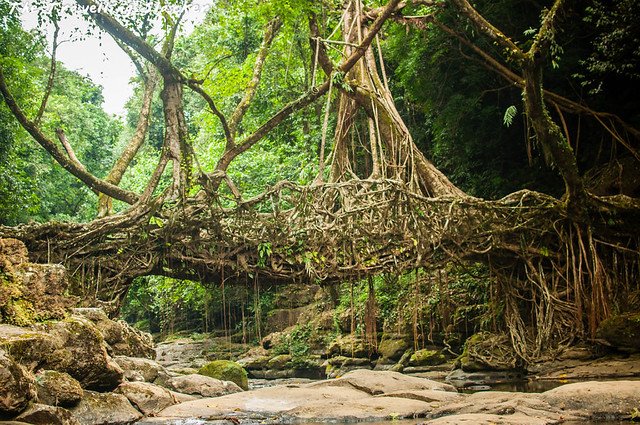
Deep in the misty hills of Meghalaya, bridges don’t rise from concrete or steel. They grow, slowly and patiently, shaped by human hands and nature’s rhythm. These extraordinary living root bridges, hidden among forests and flowing streams, have now caught global attention, with India officially submitting their nomination to UNESCO for the 2026–27 World Heritage evaluation.
Spread across the southern slopes of the Khasi and Jaintia Hills, these bridges are the result of centuries-old wisdom. Local communities have long guided the aerial roots of rubber fig trees across rivers, training and weaving them until they form strong, walkable crossings. Over time, the roots thicken and strengthen, making the bridges more durable with age. What began as a practical solution to crossing rivers has evolved into a powerful symbol of harmony between people and nature.
Earlier this year, India sent a detailed dossier to UNESCO in Paris, presenting the living root bridges as a rare example of a living cultural landscape. The submission highlights how these structures blend ecological strength with cultural tradition. If they are added to the World Heritage List, they will bring international recognition to Meghalaya and shine a spotlight on the communities that have preserved this knowledge for generations.
These bridges are not just visual wonders meant for photographs. They reflect a way of life rooted in sustainability, where natural materials are used thoughtfully and allowed to grow stronger over time. The skill of shaping roots is passed down within families and villages, making it as much a cultural legacy as an engineering feat. Built to endure heavy monsoon rains, the bridges have stood firm for decades, even centuries.
Visitors to Meghalaya often trek through dense forests and past waterfalls to reach some of the most famous bridges, including the much-admired double-decker root bridge at Nongriat. The journey itself offers a close look at village life, local customs and the deep connection the Khasi people share with their land.
If UNESCO recognition comes through, Meghalaya could see a rise in responsible tourism, stronger conservation efforts and a renewed sense of pride among indigenous communities. As the world waits for the final decision, these living root bridges stand quietly in the hills, continuing to grow and reminding us that the most enduring structures are often built with patience, respect and balance with nature.