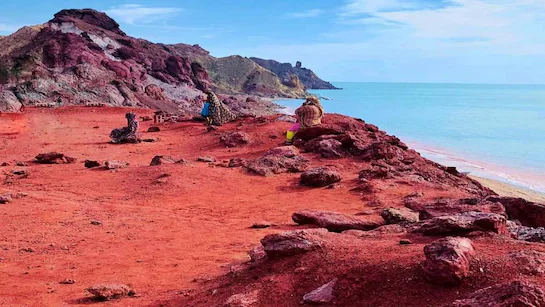
Along the shores of Iran’s Hormuz Island, a remarkable natural sight draws visitors from around the world. Here, the coastline looks almost unreal. Instead of golden or white sand, the beach is covered in deep crimson shades that stretch along the edge of the Persian Gulf. Known as Red Beach or Sorkh Beach, this unusual destination has fascinated scientists, photographers, and travellers for many years.
The dramatic landscape creates a striking visual contrast. Bright red sand meets the clear turquoise waters of the Persian Gulf, forming a colourful scene that is rarely found anywhere else on Earth.
Hormuz Island sits close to the Strait of Hormuz, one of the world’s most important shipping routes. While the strait is often discussed for its strategic and geopolitical importance, the nearby island quietly holds one of the region’s most unique geological wonders.
The unusual colour of the beach comes from the minerals present in the soil. The sand on Hormuz Island contains a very high amount of iron oxide, the same compound that gives rust its reddish colour. Over millions of years, natural weathering and mineral deposits slowly shaped the coastline, turning the sand into the rich red colour seen today. When sunlight hits the shore, the iron particles sparkle and make the landscape look even more dramatic.
For geologists, Hormuz Island is an important place for studying Earth’s history. The mineral-rich terrain reflects millions of years of tectonic movements and sediment formation in the Persian Gulf region.
The red soil of the island is locally known as gelak, and it plays an interesting role in the daily life of the island’s residents. Because of its strong pigment, even a small amount of this soil can easily stain skin, clothes, or other surfaces.
For generations, locals have used gelak in traditional cooking. Instead of eating the soil directly, small amounts are mixed into the preparation of sooragh, a fermented fish sauce that is known for its bold taste and deep red colour.
Gelak has also been used in other ways. In the past, it served as a natural dye for textiles and pottery. Even today, small quantities of the mineral-rich soil are exported and used to make pigments, cosmetics, and handmade crafts.
One of the most fascinating sights on Red Beach appears when the waves roll over the shore. As the water mixes with the iron-rich sand, shades of pink and red spread across the surf, creating swirling patterns in the water.
The colours become even more spectacular during sunrise and sunset, when the coast glows in rich shades of ruby and coral. In earlier times, sailors travelling through the nearby Strait of Hormuz could spot the red shoreline from a distance and sometimes used it as a natural landmark for navigation.
Beyond science, the island is also surrounded by local legends. Some stories speak of ancient battles, mysterious creatures, or cosmic events that supposedly turned the sand red. Although science explains the real reason behind the colour, these stories continue to add a sense of mystery to the island.
Today, Hormuz Island remains a fascinating place where nature, culture, and storytelling come together — creating one of the most extraordinary coastlines in the world.