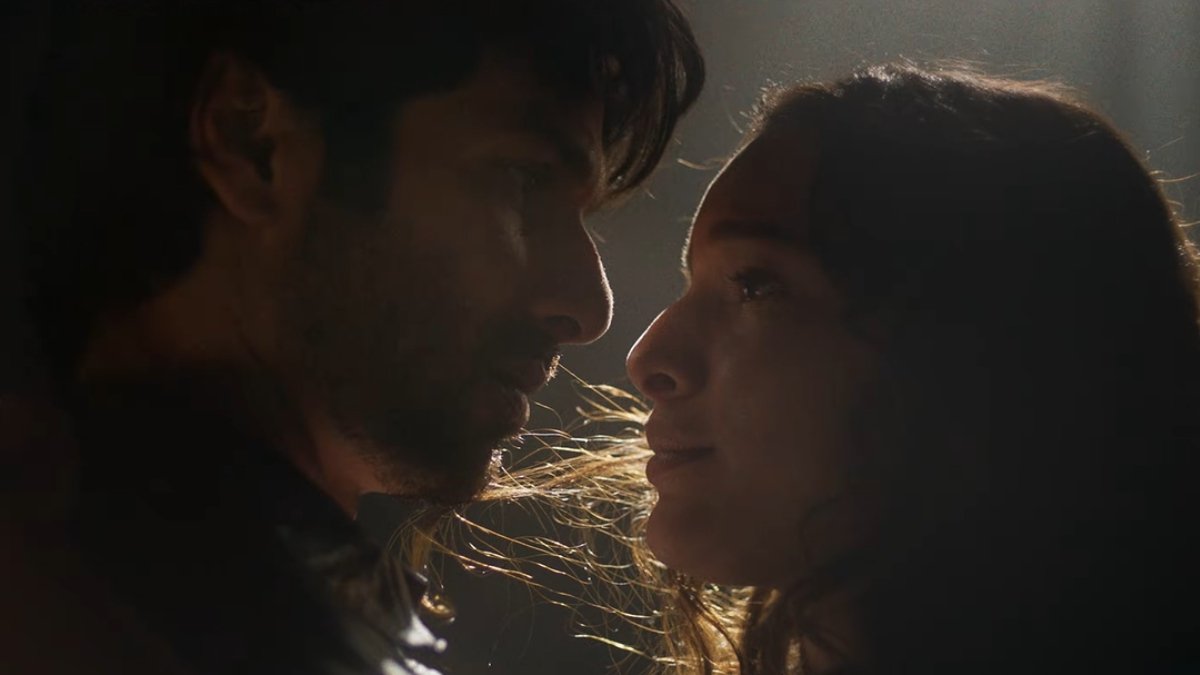
When Vishal Bhardwaj and Shahid Kapoor walk into a cinema together, you do not simply watch a film — you carry the weight of Kaminey and Haider in with you. That weight, it turns out, cuts both ways.
After four days in cinemas, O Romeo has collected ₹61.3 crore worldwide, with India nett standing at ₹46.75 crore and an additional ₹15 crore arriving from overseas. The makers called it “steady love.” Trade analysts called it a Monday test passed. The truth, as with everything Bhardwaj touches, is a little more layered than that.
The Box Office Story
The film opened at ₹8.5 crore on Day 1, jumped 49% to ₹12.65 crore on Saturday, dipped to ₹9 crore on Sunday, and registered ₹4.75 crore on its first Monday — a 43–50% weekday drop that is entirely standard for a mid-budget Hindi release.
In just four days, O Romeo has entered the Top 10 highest-grossing films of Shahid Kapoor’s career and sits tantalisingly close to surpassing Kaminey’s entire India lifetime haul of ₹41.3 crore. That milestone alone is worth pausing on. The film that launched the Bhardwaj-Kapoor mythology is about to be eclipsed commercially by their fourth chapter together — and yet Kaminey remains the one critics keep invoking as the gold standard they wished O Romeo had reached.
O Romeo has also crossed the lifetime worldwide collection of Shahid Kapoor’s previous release, Deva (₹55.8 crore), in just four days — a clean, emphatic statement about the drawing power of the Bhardwaj-Kapoor brand, even when the product divides opinion.
The Critical Story
O Romeo received a mixed critical reception, with praise largely concentrated on its performances, cinematography, and action sequences, while the screenplay — particularly in the second half — drew consistent fire.
The film has the mood, the performances, and flashes of the poetic storytelling you expect from a Vishal Bhardwaj film. Shahid Kapoor holds your attention from the first frame, and the music — composed by Bhardwaj with lyrics by the legendary Gulzar — lingers long after you leave the theatre. But the film doesn’t quite come together, particularly after the interval where the writing weakens and the emotional impact slowly fades.
The comparison angle is where this film lives and breathes. Multiple critics described O Romeo as the gritty world of Kaminey wrapped into the haunting chaos of Haider — but advised audiences to shed the burden of those expectations before walking in, arguing that without the comparison weight, O Romeo stands as genuinely good cinema. It is a film that suffers most when measured against the filmmakers’ own legacy.
At 178 minutes, the runtime is arguably the film’s most debated character. The Hollywood Reporter India noted that the film slaps on style to offset a narrative that flirts between looking cool, being commercially accessible, and being a throwback to gangster films of an earlier era — a tension that Bhardwaj never fully resolves.
The Performances
One verdict is near-universal across the critical spectrum: Shahid Kapoor delivers an outstanding performance, and his screen presence alone makes the film worth the price of admission. His Hussain Ustara is jagged, broken, and dangerously quiet — something shifts in his DNA when he enters Bhardwaj’s world, and he pulls off both loud volatility and haunting silence with equal and effortless conviction.
Triptii Dimri brings fierce, modern agency to her role as Afshan — arguably the film’s emotional backbone. Vikrant Massey, Tamannaah Bhatia, Disha Patani, Farida Jalal, and Avinash Tiwary appear in extended cameos that light up individual scenes without overstaying their welcome. Nana Patekar, as ever, is an event entirely unto himself.
The Bhardwaj-Kapoor Ledger
There is a quietly unsettling pattern running through the Bhardwaj-Kapoor filmography that no box office tracker captures but every serious cinephile feels. Kaminey (2009) earned ₹41.3 crore India nett and became a cult classic almost instantly — raw, risk-taking, and gloriously uninterested in playing it safe. Haider (2014) earned less — ₹36 crore nett — and won three National Awards, widely regarded as one of Hindi cinema’s finest Shakespeare adaptations and a landmark in modern Bollywood. Rangoon (2017) collapsed commercially at ₹22 crore and the partnership went dormant for nearly a decade.
Now O Romeo arrives at ₹46.75 crore India nett in just four days — their biggest commercial opening together by a considerable margin — and yet the critical conversation is the most divided it has ever been.
The pattern, once you see it, is hard to unsee: every time this duo chases wider commercial ground, the artistic consensus narrows. Kaminey was unfiltered and fearless. Haider was uncompromising in its tragedy. O Romeo, by contrast, has the instincts of a Bhardwaj film dressed in the clothes of a mainstream gangster spectacle — technically accomplished, emotionally ambitious, but ultimately cautious in the places where Bhardwaj’s best work was never cautious at all.
It is the most people have ever paid to see this partnership. And the least certain they have been about what they watched. In the long arc of Hindi cinema, that tension between commerce and craft rarely resolves cleanly. O Romeo is proof that even the most gifted collaborators are not immune to it — and that the marketplace has a habit of rewarding accessibility precisely at the moment when an artist decides to offer it.
Verdict
O Romeo is not Haider. It was never going to be. What it is, is a film with a formidable director working in full visual command, a lead actor operating at career-best intensity, and a script that simply could not hold the full weight of the ambition placed upon it. You walk out entertained in flashes — and strangely unmoved in the spaces between them.
At ₹61.3 crore worldwide in four days, audiences are clearly showing up. Whether they are leaving satisfied is the far more interesting conversation — and one that the film’s upcoming OTT run on Amazon Prime Video will answer far more conclusively than any opening weekend ever could.