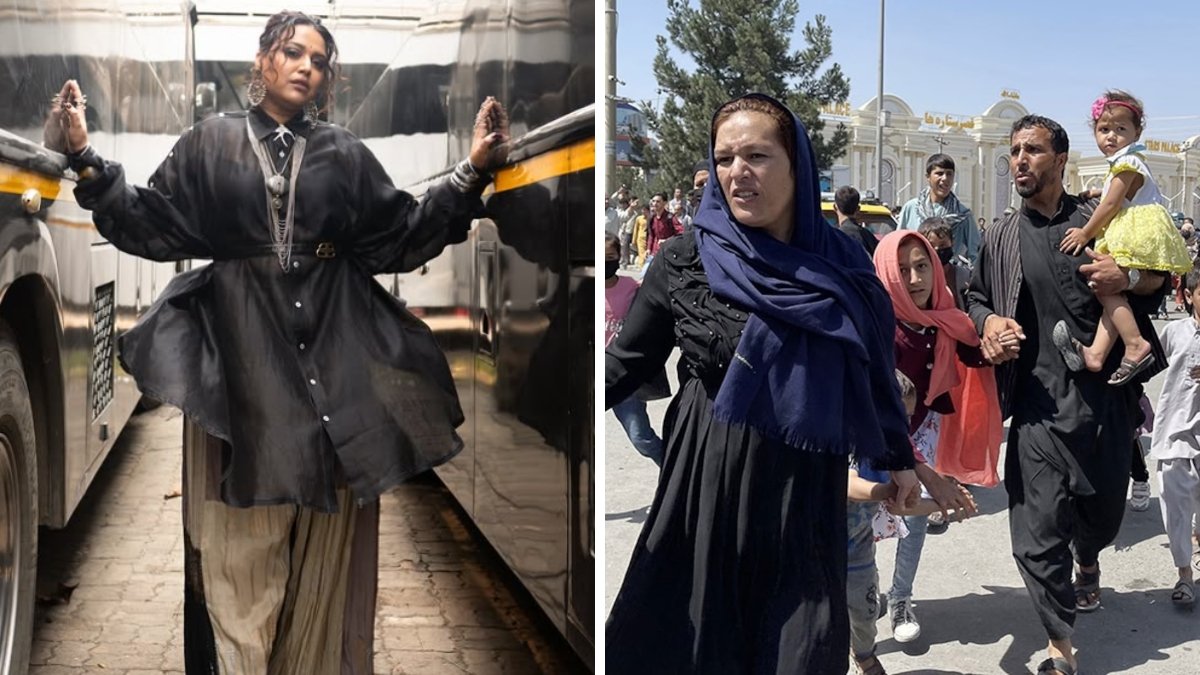
Bollywood actress Swara Bhasker has issued a furious public response to the Taliban’s newly signed penal code. She posted her reaction on Instagram Stories on Friday, and her words cut straight to the point.
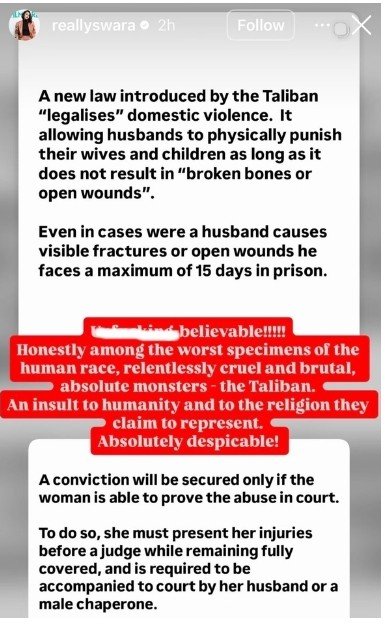
“Unf**king-believable!!!!! Honestly among the worst specimens of the human race, relentlessly cruel and brutal, absolute monsters the Taliban. An insult to humanity and to the religion they claim to represent. Absolutely despicable,” she wrote.
However, what separates this moment from a celebrity venting online is the law itself — and how little the world is saying about it.
What the New Taliban Law Actually Says
Taliban supreme leader Hibatullah Akhundzada signed a sweeping 90-page criminal code called the De Mahakumu Jazaai Osulnama. Courts across Afghanistan now use it as their legal framework. Furthermore, the document took effect immediately, with no public announcement or consultation.
Under the code, a husband can beat his wife. Punishment applies only if he uses a stick and causes severe injury. Even then, the maximum sentence he faces is just 15 days in prison. Additionally, the burden of proof falls entirely on the woman — not the perpetrator.
The law goes further still. If a woman leaves her husband’s home without his permission, she can face up to three months in jail. Relatives who shelter her can also face criminal charges. In other words, the law does not just permit abuse — it actively punishes anyone who tries to help a victim escape it.
A Legal Caste System — Written Into Law
Beyond the domestic violence provisions, the code creates a formal social hierarchy. Under Article 9, Afghan society divides into four tiers: religious scholars, the elite, the middle class, and the lower class. Crucially, the punishment for the same crime differs depending on which tier a person belongs to.
Religious scholars face only verbal advisement. Members of the elite may be summoned and counselled. The middle class can face imprisonment. Those in the lower class, however, face both imprisonment and corporal punishment. The document also refers to “free persons” and “slaves” as separate legal categories — a distinction that human rights groups say directly contradicts international law.
The Bottom Line
The Taliban’s new penal code is not a fringe development. It is a signed, distributed, court-enforced legal document. It permits domestic violence. It jails women for leaving home. It sorts human beings into legal classes that determine whether they face prison, flogging, or simply a conversation.
Swara Bhasker called it what it is. Given the silence coming from those with far more power to act, perhaps that is exactly what this moment needed.