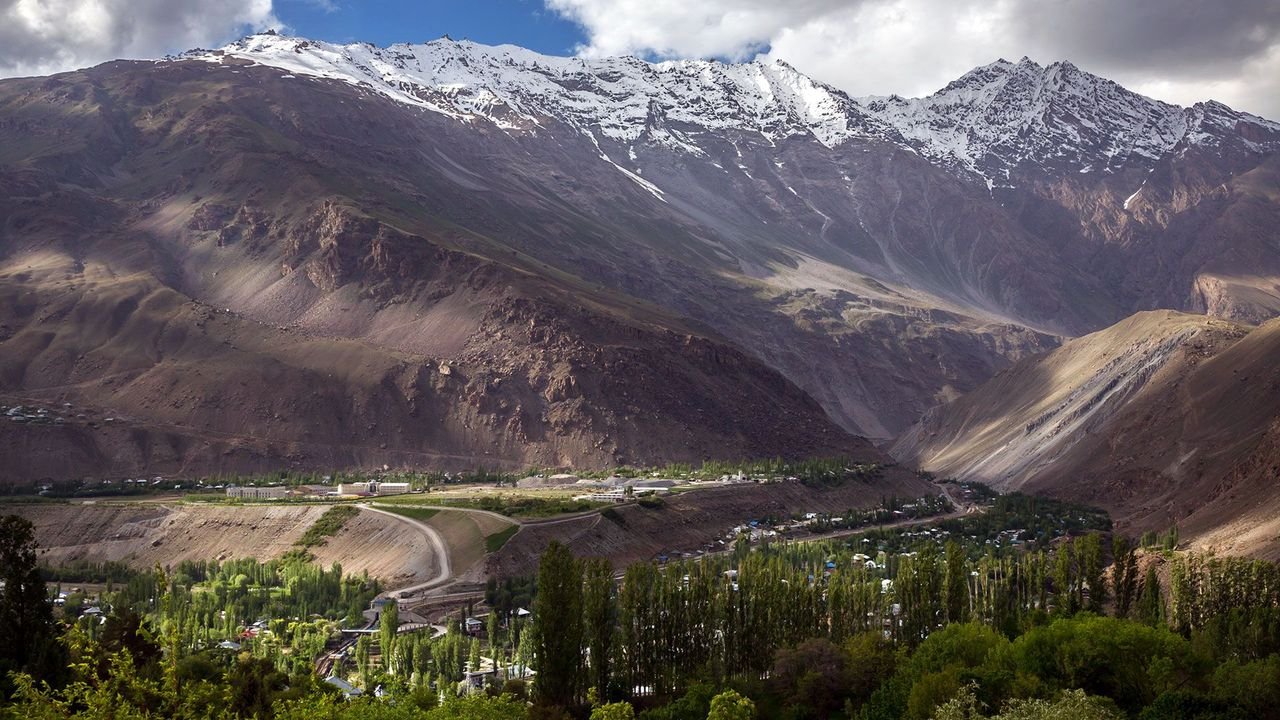
High above sea level, where massive mountain ranges collide and the sky seems almost within reach, lies one of the most extraordinary landscapes on Earth—the Pamir Mountains. Often called Bam-i-Duniya, or the “Roof of the World”, this remote region is known for its towering peaks, dramatic valleys and breathtaking views that have fascinated travellers for centuries.
The Pamir Mountains are located mainly in eastern Tajikistan, but their vast stretch also reaches into Afghanistan, China’s Xinjiang region, and Kyrgyzstan. Because several of Asia’s most famous mountain systems meet here, the area forms one of the highest plateaus in the world.
Some of the region’s most impressive peaks include Ismoil Somoni Peak, which rises to about 7,495 metres, along with Independence Peak and Kaufman Peak. These mountains dominate the landscape and are surrounded by glaciers, high-altitude plains and stunning turquoise lakes that make the region feel almost untouched by time.
The Pamirs earned their famous nickname, “Roof of the World”, because of their extreme height and unique geography. The plateau sits at an average elevation of more than 4,000 metres above sea level, creating sweeping views that stretch endlessly across rugged mountain terrain.
For generations, travellers and explorers have described the Pamirs as a place where the Earth seems to meet the sky. Even today, that description continues to capture the region’s mysterious beauty and powerful presence.
The mountains are not only known for their dramatic scenery but also for their deep historical significance. For centuries, the Pamir region served as an important crossroads along the ancient Silk Road, the famous trade route that once connected Asia with the rest of the world. Merchants, explorers and adventurers passed through these highlands while travelling between distant civilizations.
Geographically, the Pamirs are especially unique because they sit at the meeting point of several major mountain ranges, including the Himalayas, Karakoram, Hindu Kush, and Tian Shan. This rare convergence creates a striking landscape where peaks often rise above 4,000 metres, with some reaching nearly 7,500 metres.
Today, the Pamir Mountains attract travellers seeking both adventure and cultural discovery. Along with spectacular scenery, visitors can explore the region’s rich heritage and experience a landscape that feels truly untouched.
For those planning a journey, the best time to visit the Pamir Mountains is between June and September, when the weather is more suitable for travel and exploration.